 VCT
Databricks: Hijacked npm packages drive over 99% of malicious downloads
A Databricks analysis of about 5,400 malicious npm packages finds attackers shifting to build pipelines and AI development tools.
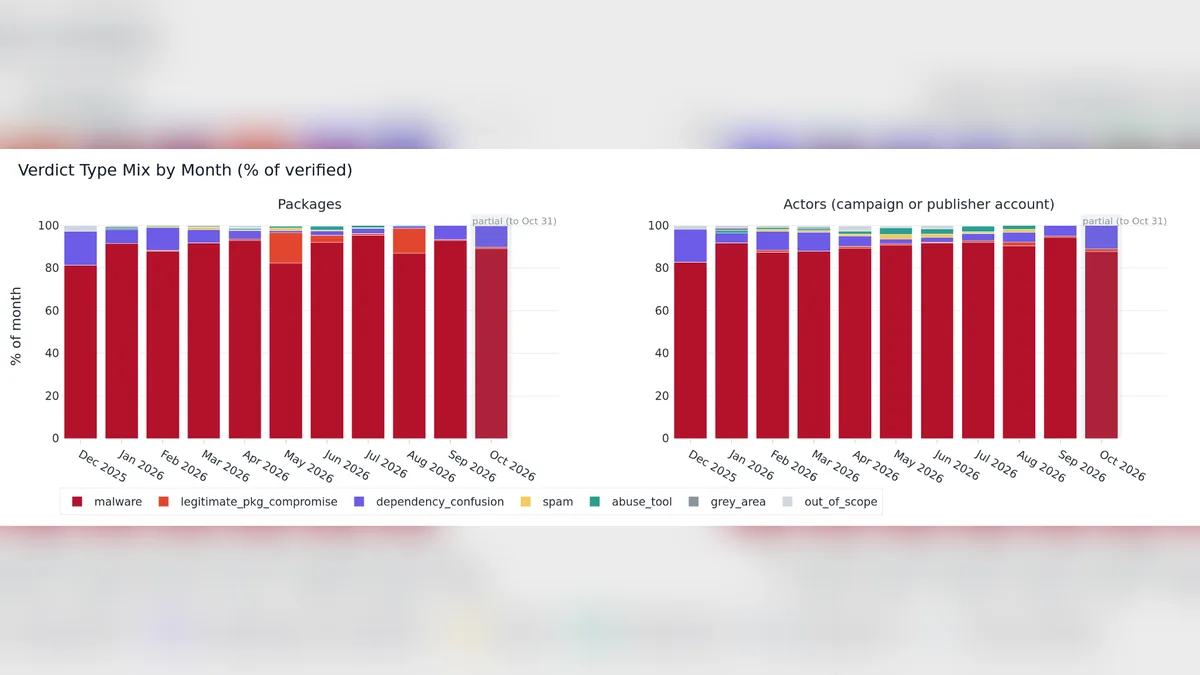
Databricks analyzed roughly 5,400 npm packages confirmed as malicious, all published from December 2025 to October 2026. According to the report, hijacked legitimate packages are 7% of the set but receive over 99% of downloads. The company says attackers have moved toward build pipelines and AI development tools.
Packages that attackers created themselves make up 89% of the set, according to Databricks, yet draw only 0.2% of recorded downloads. Of packages in the set that use trusted publishing, 85% are compromised legitimate ones.
AI tooling and shared services
The report describes a separate class of activity aimed at AI development tools. It includes MCP server packages that take credentials from the agent host. Others edit AI assistant configuration files, and a third group steals AI service keys.
According to the report, 38% of malicious packages talk to a legitimate third-party service. Examples include serverless hosting and chat-platform webhooks. Databricks says domain reputation cannot tell this traffic apart from normal developer traffic.
Removal lags behind reporting
Databricks found that 87% of confirmed packages have a public advisory. The registry's security takedown follows later, at a median of 7 days, and 10% take longer than 59 days. The publishers themselves unpublished 37% of attacker-created packages, at a median of seven hours. Even so, 16% could still be installed during the analysis.
Databricks checked registry status on November 6, 2026. The company says 54% of packages declare a lifecycle script, so install-script controls cover about half of the observed malware. The report is the first in a series on the supply chain threat landscape.
Related stories
Cloud & Infrastructure
Microsoft pitches Copilot as the work operating system at Ignite 2026
Developer Tools
sqlite3_rsync copies SQLite database snapshots over SSH
Developer Tools