VCT
Hugging Face agent raises Inkling 2 Mini single-user decode 40% on one RTX PRO 6000
A coding agent tuned vLLM nightly with DSpark speculative decoding, taking single-user decode from 136 to 190.6 tok/s in an afternoon, says Hugging Face.
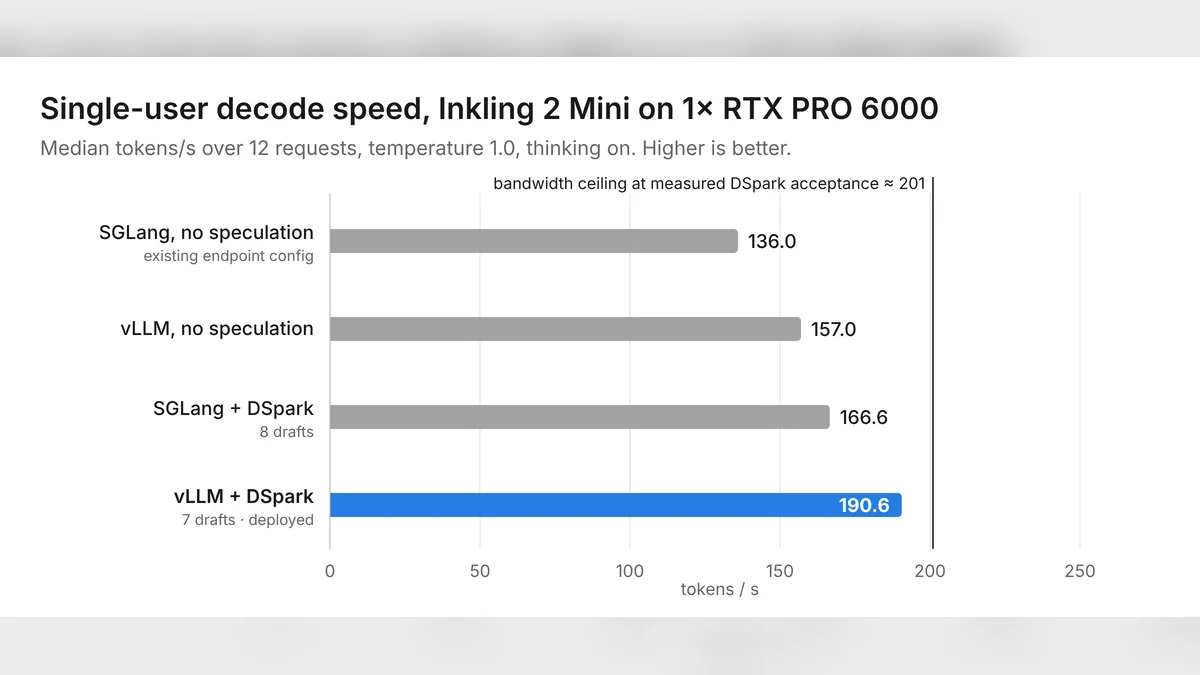
Hugging Face let a coding agent spend an afternoon tuning Inkling 2 Mini for one NVIDIA RTX PRO 6000 with 96 GB of memory. Across 46 valid benchmark runs, single-user decode rose from 136 to 190.6 tok/s, a 40% gain. The best setup combines vLLM nightly with DSpark speculative decoding and now runs as an Inference Endpoint.
According to Hugging Face, 8-user aggregate throughput rose from about 570 to 716 tok/s, a 26% gain. The company says the single-user figure beats a 167.7 tok/s community benchmark on LocalMaxxing for the same GPU. Greedy outputs match byte for byte with and without speculation.
How the agent worked
The agent had an inference-optimisation skill, the hf CLI and Jobs compute. The skill's protocol changes one variable per test and brackets each candidate between two control runs.
Switching from SGLang to vLLM nightly added 15% without speculation, from 136 to 157 tok/s. DSpark with 7 drafts and probabilistic draft sampling added another 21%. Two memory flags were needed for the setup to start on 96 GB.
A bandwidth ceiling
The agent measured 1,469 GB/s of copy bandwidth on the card. It estimated a single-user ceiling of about 256 tok/s without speculation. With speculation, that ceiling falls to about 201 tok/s at the measured acceptance rate. At 190.6 tok/s, the setup reaches roughly 95% of it, according to Hugging Face.
The team pinned the vLLM nightly image digest and deployed the config on an nvidia-rtx-pro-6000 endpoint at $2.75/h. A benchmark against the live endpoint measured 194.9 tok/s for a single user. Logs, scripts and raw measurements sit in the NielsRogge/inkling-2-mini-hillclimb repository.